
Reviewed · DOLPHIN WATCHING
Whale and Dolphin Watching with a Biologist in Puerto Vallarta
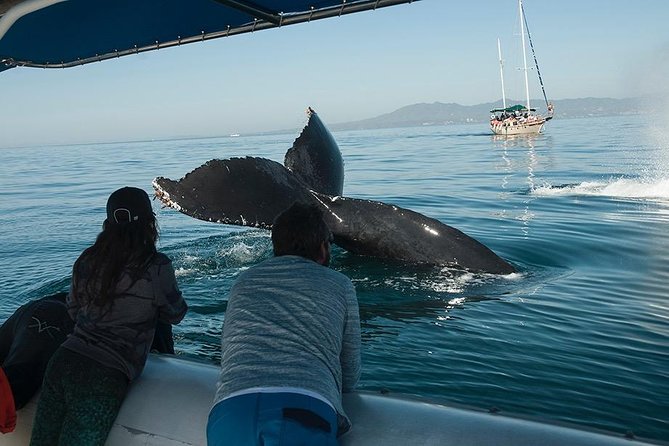
The best part of this Puerto Vallarta outing is that you are not simply chasing whale tails. A marine biologist explains what you are seeing, from a mother teaching her calf to communicate to males competing for a female, while the crew gathers useful information for ongoing research. Whale song through a hydrophone can be as memorable as a breach.
I like two things right away: the small boat, which gives you a clear view from both sides, and the guide’s scientific eye. Guides such as Jemma, Gemma, and Camilla have helped guests understand why a whale surfaces, slaps its tail, or changes course. The only real caution is that wildlife sets the schedule. One trip may begin slowly, while another sees whales within 15 minutes.
In This Review
- Key points to know before booking
- Why this whale trip feels different
- Meeting the whales of Banderas Bay
- Humpbacks, calves, and the moments you remember
- Dolphins, turtles, mantas, and bonus sightings
- The small-boat tradeoff
- What the four hours are worth
- Morning or afternoon?
- Who should book this experience?
- Should you book the Puerto Vallarta whale tour?
- FAQ
- Where does the tour begin?
- Where does the tour end?
- How long does the whale-watching tour last?
- How much does the experience cost?
- What animals might I see?
- Is a marine biologist included?
- Does the tour include whale songs?
- How many people can join the tour?
- Is there a bathroom on the boat?
- What happens if the weather is poor?
- Can I cancel for a full refund?
Key points to know before booking
- Marine biologist on board: Guides explain cetacean behavior and connect sightings to active research programs.
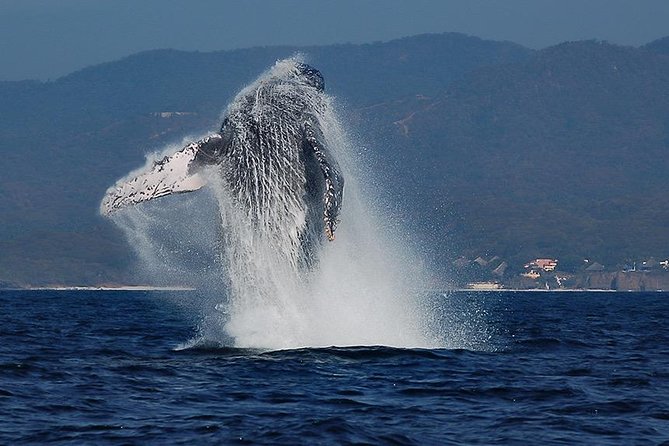
- Humpback season: Winter brings humpback whales to Puerto Vallarta to mate and give birth.
- More than whales: You may also see bottlenose, spotted, spinner, or rough-toothed dolphins, plus turtles and giant mantas.
- Hydrophone experience: The crew may place an underwater microphone in the sea so you can hear whale songs.
- Small covered boat: Groups are capped at 20, with many departures carrying about 12 to 16 people.
- Research with a refund promise: The operator says its experience helps it find the animals and promises a refund if no animals are found.
Why this whale trip feels different
Many whale excursions are mainly a boat ride with a search attached. This one puts biology at the center. Before heading out, you can expect an educational introduction covering the whales you may encounter and the behavior to watch for. Some guides use baleen and a whale vertebra as teaching tools, giving you a sense of the animal’s size before you see one in the bay.
That preparation matters. A humpback’s back may appear for only a few seconds, and a distant blow can be easy to miss if you do not know what to watch for. With a biologist pointing out the pattern, you begin to read the surface: a blow, a rolling back, a fluke rising before the animal disappears, or a calf practicing a new movement.
The guides are marine specialists, not just boat narrators. The team includes biologists with master’s degrees in marine ecology, a science journalist, and a professional wildlife photographer whose work has appeared with National Geographic and Animal Planet. The assigned guide varies, but Jemma, Gemma, and Camilla are among the names associated with recent trips.
I especially like the research connection. Your participation helps support programs focused on whales and dolphins, and the guide explains how observations contribute to that work. This does not turn you into a field scientist in four hours, but it gives the outing a purpose beyond getting a photograph.
More Puerto Vallarta trips worth a second look
- Watch and Swim with Dolphins in the Wild
★ 4.5 · 668 reviews - Puerto Escondido: Boat Tour to see Dolphins and Marine Life
★ 4.6 · 467 reviews - Dolphin & Whale Watching in Puerto Escondido
★ 5.0 · 278 reviews
Meeting the whales of Banderas Bay
The tour begins at Opequimar Centro Marino in Marina Vallarta, at Avenida Paseo de la Marina Sur 214. You return to this same point after roughly four hours. Confirmation is sent within 48 hours of booking, subject to availability, so do not leave this reservation until the last minute if your schedule is tight. The activity is commonly booked about 26 days ahead.
Once the group is aboard, the crew heads into the bay. The boat is small and covered, with reported group sizes ranging from about 12 to 16 people and a maximum of 20. That size is useful for whale watching. You are less likely to have a wall of people blocking the view, and the guide can speak directly to the group.
The captain’s work is just as important as the biologist’s. Jorge and Cesar are among the captains praised for safe handling and good positioning. A good whale boat does not simply rush at an animal. It approaches carefully, keeps a respectful distance, and places you where a surfacing whale might be visible without putting pressure on it.
Some outings reach active whales quickly. One reported trip began seeing them within about 15 to 20 minutes. Other trips have taken close to an hour before the action began. That difference is normal for a wild-animal excursion, and it is why I would not book this if you need a guaranteed sequence of dramatic sightings at set times.
Once whales are located, the boat may remain in an area for a while. You might watch several adults moving together, a mother and calf, or males competing for access to a female. The guide explains the behavior as it unfolds, which turns a series of brief sightings into a connected story.
Humpbacks, calves, and the moments you remember
Puerto Vallarta’s winter visitors are humpback whales. They arrive in the region to mate and give birth, so the bay can include adults, mothers with young calves, and males moving around females. The exact mix changes from day to day.
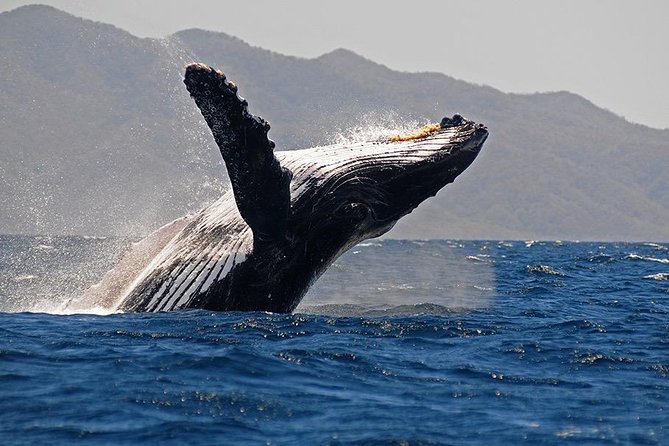
A calf may breach, roll, or slap its tail near its mother. You might see a mother repeatedly tail-slap while teaching a young whale to communicate. Another memorable possibility is a group of males competing for a female, an active scene that can involve several whales surfacing close together.
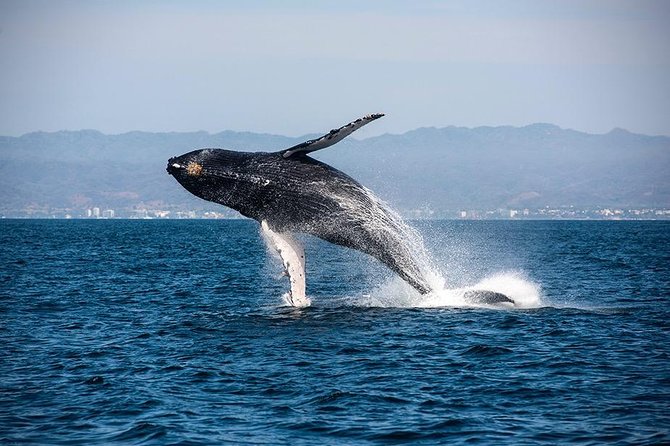
Breaching is never promised, but it happens. Some outings have included multiple breaches, with one group seeing more than 25 aerial displays in an afternoon. Other sightings are quieter: a whale’s back sliding past the boat, a fluke lifting into the air, or a blow appearing far away and then drawing closer.
The guide helps you appreciate both kinds of encounters. A breach makes a wonderful photograph, but a mother and calf traveling together can tell you more about whale behavior. The small boat also helps with photography because you can shift your position and watch both sides. Still, you should expect fast action and changing light, not a staged wildlife show.
One useful detail is the whale-song session. The crew may use a hydrophone, an underwater microphone, to let you hear the sounds of males below the surface. The songs can come from whales nearby or echo from farther away. Hearing them adds a whole new sense to the outing and reminds you that much of the activity is happening beneath the water.
Dolphins, turtles, mantas, and bonus sightings
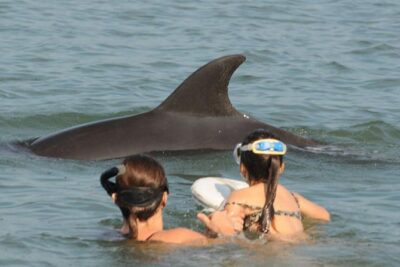
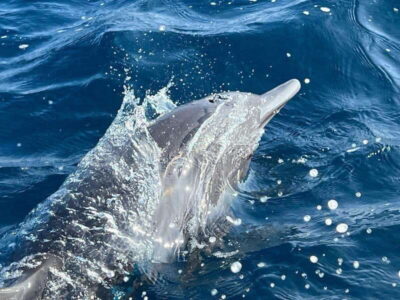
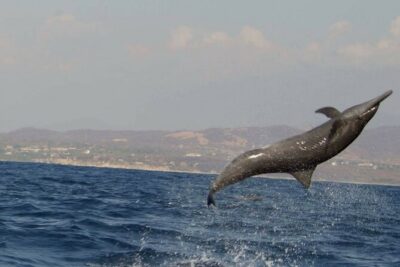
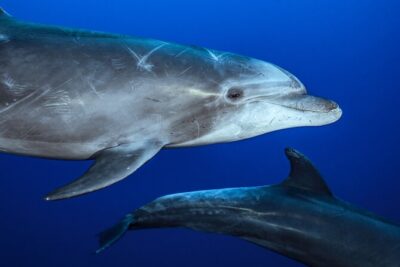
The winter outing combines whale watching with dolphin watching. Possible species include bottlenose, spotted, spinner, and rough-toothed dolphins. Orcas or false orcas are possible but much less certain, so treat them as a lucky extra rather than a promised feature.
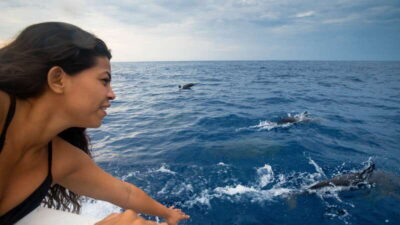
Dolphin groups can change the mood of the trip. They may travel near the boat or appear in another part of the bay after the whale search. The biologist can explain differences in body shape and behavior, helping you distinguish a quick-moving spinner dolphin from a larger bottlenose dolphin.
You may also see marine turtles and giant mantas. These animals are not the main reason to book, but they broaden the experience. Recent outings have included manta rays, turtles, a sea lion, and blue-footed boobies. Seeing a variety of animals makes the trip worthwhile even during a quieter whale period.
The tour may also reach the Marietas Islands, depending on where the animals are. That is not presented as a separate island sightseeing program, so do not book it expecting a full island visit. The focus remains on finding marine life and observing it responsibly.
A different kind of day out, same stretch of Mexico:
- Puerto Vallarta Best Zipline Canopy + Tequila and Speed Boat Ride
★ 5.0 · 3,786 reviews - Winner 2025 Downtown Vallarta Food Tour with Vallarta Food Tours
★ 5.0 · 3,738 reviews - Extreme Adventure, Wildest Bridge, ATV & Ziplines
★ 5.0 · 3,179 reviews - Mega Yacht ALL INCLUSIVE Yelapa Waterfall & Snorkeling Adventure
★ 5.0 · 2,515 reviews
The small-boat tradeoff
A boat carrying no more than 20 people is a strong choice for viewing. You can usually see over the shoulders of fewer people, and the guide can move around the group. A covered boat is also helpful in strong sun and on windy days.
The tradeoff is comfort. This is a working wildlife boat, not a large sightseeing vessel with every facility. One important detail: there is no bathroom on board. Use facilities before departure and plan accordingly, particularly if you are traveling with children or prefer easy access to restrooms.
The ride can also feel active. The boat must move to locate animals, and the sea can become windy. The crew provides life jackets and helps people board safely. Anyone prone to motion sickness should consider bringing the remedy they normally use, though the tour information does not specify an onboard medical supply.
The boat is suitable for most participants, and service animals are allowed. It is not recommended for people more than seven months pregnant. If you have a concern about mobility, balance, or boarding, ask the provider before booking rather than assuming the small boat will suit you.
What the four hours are worth
The price is $105 per person. That is more than a basic harbor cruise, but you are paying for a small group, a specialist guide, an experienced captain, and a research program supported by the outing. The guide’s interpretation is the main value. Without it, a distant blow is simply a distant blow. With it, you learn what the whale may be doing and why the crew is positioning the boat in a certain way.
Food and drinks may be part of the onboard service. Some outings have included sandwiches and soft drinks, and one guide prepared sandwiches for the group. I would still treat that as a pleasant provision rather than the reason to book, since the supplied details do not define a fixed menu.
The operator also says it can guarantee finding the animals or refund your money. That is an unusually strong promise for a wildlife trip, but you should still understand the practical point: conditions and sightings can vary, and any refund would be subject to the provider’s stated terms. The cancellation policy allows a full refund when you cancel at least 24 hours before the start time.
If poor weather forces cancellation, you can choose another date or receive a full refund. The same applies if the minimum number of participants is not reached. Changes or cancellations within 24 hours are not refunded, so keep an eye on the local start time.
Morning or afternoon?
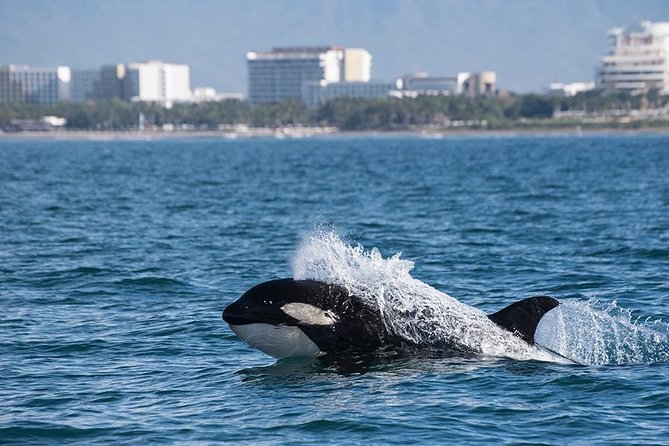
The available information does not establish that one departure is always better. One afternoon outing produced a remarkable run of sightings after a morning trip had seen none, but that is a reminder of nature’s unpredictability, not proof that afternoons win.
I would choose the time that fits your schedule and leaves room for the possibility of a slow start. The tour lasts about four hours, and whales do not follow a timetable. If you are choosing between two equally convenient departures, ask the provider about current conditions, but do not expect a guaranteed answer.
Bring sun protection, a camera, and a light layer for wind. Keep your phone or camera secure, and remember that the best moment may happen on the opposite side of the boat. The covered roof helps with sun, but it does not remove the need for practical clothing.
A small cash tip is also worth planning for if you feel the crew did a good job. It is not listed as an included cost, and one birthday outing specifically noted bringing cash for tips.
Who should book this experience?
This is a strong fit for first-time whale watchers, families with older children and teenagers, couples, and anyone who wants facts along with photographs. The guide’s explanations make it easier to stay interested during quiet stretches, while the small group keeps the outing personal.
It is especially well suited to people who care about wildlife protection. Your fee supports research, and you get to learn how biologists study whales and dolphins in the wild. That connection gives the trip more substance than a simple sightseeing ride.
You may want another option if you need a restroom on board, dislike boat motion, or want a large vessel with extensive amenities. You should also think twice if your schedule cannot handle a variable wildlife search. The provider’s animal-finding promise offers reassurance, but no ethical whale tour can make a humpback breach on command.
Should you book the Puerto Vallarta whale tour?
I would book this tour during the winter whale season if you want a close look at marine life and a guide who can explain what you are seeing. The strongest reasons are the marine biologist, the hydrophone, the small covered boat, and the chance to support whale and dolphin research.
The best version of the day may include mothers and calves, several males, dolphins, turtles, and a breach near the boat. The quieter version may take longer to find animals, but you still get a science-led outing in their natural setting. Choose it for the quality of the experience, not just for a checklist of sightings.
FAQ
Where does the tour begin?
The tour begins at Opequimar Centro Marino, Avenida Paseo de la Marina Sur 214, Marina Vallarta, Puerto Vallarta, Jalisco, Mexico.
Where does the tour end?
The activity ends back at the same meeting point in Marina Vallarta.
How long does the whale-watching tour last?
The tour lasts approximately four hours.
How much does the experience cost?
The listed price is $105 per person.
What animals might I see?
You may see humpback whales, bottlenose dolphins, spotted dolphins, spinner dolphins, rough-toothed dolphins, marine turtles, and giant mantas. Orcas and false orcas are possible but not guaranteed.
Is a marine biologist included?
Yes. The tour is led by a biologist specializing in cetaceans. Guides may include marine ecologists, a science journalist, or a professional wildlife photographer with marine expertise.
Does the tour include whale songs?
The crew may use a hydrophone to let you hear whales singing underwater.
How many people can join the tour?
The maximum group size is 20 people. Some outings have carried about 12 to 16 people.
Is there a bathroom on the boat?
No. There is no bathroom on the boat, so use facilities before departure.
What happens if the weather is poor?
If poor weather causes the tour to be canceled, you will be offered a different date or a full refund.
Can I cancel for a full refund?
Yes. You can cancel at least 24 hours before the experience start time for a full refund. Cancellations made less than 24 hours before departure are not refunded.
Recently reviewed around Puerto Vallarta
- Jungle Single ATV Tour “El Mirador”★ 5.0 · 59 reviews
- Bucerias Bike and Food Tour★ 5.0 · 173 reviews
- Sayulita/Punta Mita: Zip Lines with Ocean View★ 4.8 · 34 reviews
- Sayulita: Horseback Riding Tour★ 5.0 · 37 reviews
- Sayulita: Canopy Tours & Zip-line Adventure★ 4.8 · 89 reviews
- Sayulita: ATV Adventure Tour★ 5.0 · 44 reviews
- Puerto Vallarta: Baby Turtle Release in Conservation Area★ 4.8 · 110 reviews
- Puerto Vallarta: Mega Yacht Whale Watching Sunset Cruise★ 4.7 · 94 reviews
Dolphin Watching, compared.
Ocean Safari: Sea Lions, Mobula Rays, Dolphins, Orcas & Whales
Read our review →
Browse the lists this tour appears in