
Reviewed · CITY TOURS
Azcapotzalco: Mexico City’s Culinary Kaleidoscope
Azcapotzalco gives you a side of Mexico City most visitors miss: a working neighborhood where food tells the story. Over about six hours, you move from spiced coffee and sweet bread to elegant eggs, street tacos, handmade tortillas, ancient drinks, and a cocktail served in a century-old cantina.
I like the way this experience pairs serious eating with local history, especially around the Plaza de el Arbol de la Noche Triste and the old slaughterhouse district. I also like the tiny group size, capped at seven, which should make it easier to hear your guide and ask questions. Liz, one of the guides, is praised for explaining both the area and its food.
The main caution is simple: this is a lot of food in a short stretch, with plenty of walking between stops. If your stomach is sensitive, take small bites and sips, and avoid placing this tour late in your trip if you need to stay in top form.
In This Review
- Key points to know before booking
- Why Azcapotzalco makes such a good food route
- Starting with cafe de olla and a second breakfast
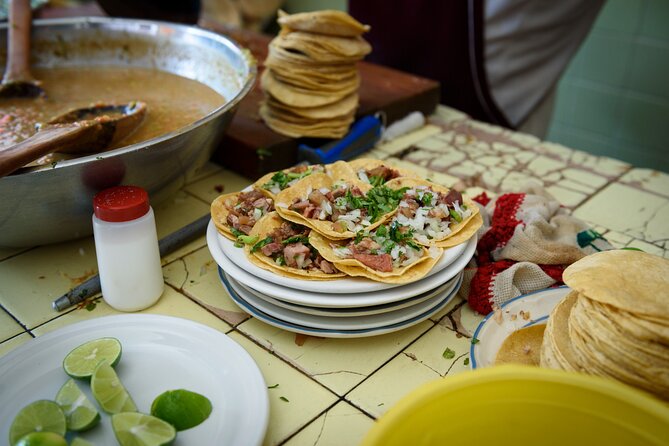
- Offal tacos and the neighborhood’s working past
- Handmade tortillas and drinks with Aztec roots
- Finishing in a 110-year-old Italian-Mexican cantina
- What the walking and timing are really like
- Is $140 a fair price?
- Food safety and pacing advice
- Who will get the most from this experience?
- Booking details that matter
- Should you book Azcapotzalco: Mexico City’s Culinary Kaleidoscope?
- FAQ
- How long does the Azcapotzalco food tour last?
- Where does the tour start and end?
- What food and drinks are included?
- Is the tour offered in English?
- How large is the group?
- Can I cancel for a full refund?
Key points to know before booking
- A food tour with a strong neighborhood focus: Azcapotzalco is presented through its daily food, old buildings, street life, and changing past.
- Seven tastings or food moments in roughly six hours: Expect cafe de olla, sweet bread, huevos encamisados, enchiladas, juices, offal tacos, handmade tortillas, traditional drinks, a cocktail, and small dishes.
- A small maximum group of seven: This is a better fit for people who prefer a close, conversational outing over a large bus-style tour.
- A serious amount of walking and eating: Wear comfortable shoes and plan for a full morning and afternoon rather than a quick snack crawl.
- An English-language experience led by guides such as Liz: The food is paired with stories about Azcapotzalco and Mexico City.
- A $140 price that depends on your appetite for context: You are paying for several food stops, a guide, and a tightly planned neighborhood experience, not simply lunch.
Why Azcapotzalco makes such a good food route
Mexico City is often introduced through its famous historic center, Roma, Condesa, Coyoacan, or the canals of Xochimilco. Azcapotzalco offers a different view. Here, the food is tied closely to the neighborhood’s working life and older traditions.
The route begins at Plaza de el Arbol de la Noche Triste in Popotla at 10:00 a.m. That meeting place gives the day a historical frame before the eating starts in earnest. The plaza is connected to one of the city’s most familiar stories from the Spanish conquest, so you begin with a reminder that Mexico City’s past is layered and often uncomfortable, not just decorative.
From there, the experience moves through Azcapotzalco on foot. The route is not built around one grand attraction. Its appeal comes from the connections between places: a family-run restaurant, a street taco stand, an artisanal tortilla shop, and a cantina that has survived for about 110 years.
That format matters. You are not simply checking off dishes. You are seeing how breakfast, snacks, drinks, meat, corn, and bar food fit into the life of one district.
More City Tours in Mexico City
- Mexico City: Teotihuacan, Tlatelolco & Guadalupe Shrine Tour
★ 4.6 · 3,773 reviews - Teotihuacan Hot Air Balloon Flight from Mexico City / Volare
★ 5.0 · 3,262 reviews - Teotihuacan Private Tour from Mexico City
★ 5.0 · 1,890 reviews
Starting with cafe de olla and a second breakfast
The first food stop follows a familiar Mexican morning rhythm: cafe de olla and a piece of sweet bread. Cafe de olla is coffee prepared with spices and traditionally associated with clay pots, though the exact preparation can vary. It is a warming, gently spiced beginning rather than a hurried cup grabbed on the way to a major sight.
The sweet bread gives you a useful first taste of the neighborhood’s everyday side. This is not the grand opening course. It is the sort of pairing that helps you understand how many people begin the day in Mexico City.
Then comes what the route calls a second breakfast, and this is where the food becomes more elaborate. At a family-run backstreet restaurant, you may taste huevos encamisados, enchiladas, freshly made juices, and other dishes.
Huevos encamisados are eggs prepared with a covering, and the dish provides a more distinctive alternative to the usual scrambled eggs or chilaquiles found on a hotel breakfast menu. The restaurant is described as one of Mexico City’s best, yet its setting is in the backstreets and its operation remains family run. That contrast is part of the point.
You should arrive hungry. The combination of the coffee, bread, eggs, enchiladas, juice, and later stops can add up quickly. If you normally eat a light breakfast, pace yourself here. You do not want to reach the taco stop already full.
Offal tacos and the neighborhood’s working past
The next part of the route turns to offal tacos. For some people, this will be the most exciting food of the day. For others, it will be the moment to decide how adventurous they really feel.
Offal can include various organ meats, and the exact tacos served is not specified. What is clear is the connection to the slaughterhouses that were once located in this part of the city. The tacos are not presented as a random dare. They make sense because they reflect the neighborhood’s former food economy.
That connection gives the dish more meaning than a novelty tasting. You can learn how local history affects what appears on a plate, and why certain ingredients become part of a district’s identity.
Still, this is a good place to be honest with yourself. If you do not eat offal, ask your guide what alternatives may be possible. The information provided does not promise substitutions, so do not book assuming you can replace every dish. You can also take a small portion rather than forcing yourself to finish something that does not suit you.
The route includes bathroom stops along the way, which is useful given the length of the outing and the number of tastings. That does not remove the need for caution, but it makes the day more manageable.
Handmade tortillas and drinks with Aztec roots
Corn is central to Mexican food, and the artisanal tortilleria stop brings that basic ingredient into focus. You will have a chance to see or sample tortillas made in a more craft-focused setting rather than treating them as an invisible side item.
A good tortilla can change the way you understand a taco, enchilada, or other corn-based dish. Even without a formal demonstration listed, the stop helps connect the meal to the work behind it: grinding, shaping, cooking, and serving one of Mexico’s most important foods.
The route also visits a third-generation street stand for drinks with roots reaching back to Aztec times. The exact drinks are not named, so you should expect traditional options without assuming one particular beverage will be served.
This part of the experience adds useful range. The day is not only about meat and restaurant cooking. It includes the old corn tradition, street vending, and beverages that point far back into the region’s past.
For many people, this may be one of the most memorable stops because it offers something you are less likely to find on a standard city food itinerary. At the same time, unfamiliar drinks can be another reason to sip slowly. You are tasting several things over many hours, not ordering one safe beverage with lunch.
More Mexico City city days:
- Mexico City: Teotihuacan Early or Afternoon Access Tour
★ 4.6 · 1,547 reviews - Historic Center Food Tour in Mexico City
★ 5.0 · 1,263 reviews - The best tour to Teotihuacán from Mexico City
★ 5.0 · 1,236 reviews - From Mexico City: Puebla, Cholula and Tonantzintla Day Trip
★ 4.3 · 1,191 reviews
Finishing in a 110-year-old Italian-Mexican cantina
The final food stop takes place in a cantina opened about 110 years ago by a family from Italy. That detail captures Mexico City’s habit of absorbing outside influences without giving up its own food traditions.
Here, you will try the house cocktail along with small dishes that combine classic Mexican ideas with elements linked to the family’s European roots. The format should feel different from the morning restaurant and street stand. Instead of ending with another large plate, you finish with a drink and small bites in a place shaped by generations of family history.
The cantina is also a good closing note because it shows that Mexico City food is not divided neatly into old and new, Mexican and foreign, home cooking and restaurant cooking. The city has long made room for different influences, then turned them into something local.
The cocktail is part of the price, so you should consider how alcohol fits into your day. If you do not drink, ask the guide about a nonalcoholic option before the tour begins. The supplied details confirm the house cocktail but do not promise a substitute.
What the walking and timing are really like
The experience starts at 10:00 a.m. and lasts about six hours, although the stop descriptions also refer to a five-hour food tour. I would plan for the longer figure and keep the rest of your day open until roughly 4:00 p.m., allowing for normal delays and the pace of a small group.
You will walk through several parts of Azcapotzalco rather than remain inside one restaurant. One direct account describes a lot of walking in new areas of Mexico City, so comfortable shoes are essential. This is not the right outing if you want a seated meal with only a few steps between courses.
The walking is part of the value. It helps you see the neighborhood between bites and understand why the food stops belong there. You are also likely to work up an appetite again after the first meal, though the quantity of food means you should not count on feeling hungry at every stop.
The group maximum is seven people. That limit is important because a food route through small businesses works better when the group can gather without blocking a narrow counter or overwhelming a family-run venue. A smaller group can also make history questions and food preferences easier to discuss.
The tour is offered in English, and the guide’s role is central. Liz is specifically praised for explaining the area and its food, so if she is leading your departure, you can expect the historical and culinary sides to receive equal attention. Guide assignments can vary, so do not book on the assumption that Liz will lead every date.
Is $140 a fair price?
At $140 per person, this is not a cheap way to eat breakfast and lunch. You are paying for the guide, the planning, several tastings, and access to a part of Mexico City that is not usually included in a first-time visitor’s basic schedule.
The value improves if you would otherwise spend a day trying to find these places on your own. The route brings together a family-run restaurant, a street taco stand, a tortilla maker, a traditional drink vendor, and an old cantina. Finding that mix independently would take time, local research, and a willingness to order unfamiliar dishes without much context.
The price is less compelling if you want large portions, a polished sightseeing route, or a simple restaurant meal. Some tastings are small dishes, and the experience is built around variety rather than one substantial lunch.
I would also factor in the price of a missed afternoon. Six hours is a sizeable block of your Mexico City schedule. If you have only two days in town and want to focus on major museums and monuments, this tour requires a real choice. If you have more time, it gives you a useful day away from the standard circuit.
The 97 percent recommendation rate and 4.8 rating from 33 ratings suggest strong overall satisfaction, but the small number of ratings means I would treat those figures as encouraging rather than decisive. The most important question is not the score. It is whether you enjoy walking, unfamiliar food, and a neighborhood-led day.
Food safety and pacing advice
One person had stomach trouble after the experience despite spending nearly a week in Mexico City without problems. The cause cannot be confirmed, and the operator says the food vendors follow strict hygiene standards, but the warning is still worth taking seriously.
Food tours can create a perfect storm for a sensitive stomach: many ingredients, different cooking methods, repeated tastings, rich dishes, and unfamiliar drinks. Eating too much too quickly may also be part of the problem.
I would use a few simple habits:
- Take small bites and sips, especially with unfamiliar foods.
- Tell the guide about dietary limits or strong dislikes before the first stop.
- Do not arrive dehydrated or already unwell.
- Use the bathroom stops when needed rather than trying to wait.
- Schedule the tour on a day when you can rest afterward if necessary.
The experience includes enough food that you do not need to prove anything. You can appreciate the history and try a small amount without treating every dish as a challenge.
Who will get the most from this experience?
I would recommend this tour to you if you like food with a story. The route is especially suitable for people who want to understand how a neighborhood eats, not just visit famous restaurants.
It also fits repeat visitors to Mexico City who have already covered the historic center and the more familiar food districts. Azcapotzalco offers a different sense of the city, with old trades, family businesses, street food, and changing local traditions.
Curious eaters will get the most from the offal tacos, traditional drinks, and regional breakfast dishes. You do not need to be an expert, but you should be open to tasting foods beyond the usual tacos al pastor and guacamole.
I would hesitate to recommend it to you if you dislike walking, need a predictable menu, want a single full meal, or have a sensitive stomach that reacts to unfamiliar ingredients. It may also be a poor choice immediately before a flight, wedding, long bus ride, or other event where stomach trouble would cause real problems.
The tour is suitable for most people, and service animals are allowed. It is near public transportation, which makes the start easier to reach, though the details provided do not specify the best route from your hotel.
Booking details that matter
Your meeting point is Plaza de el Arbol de la Noche Triste in Popotla, at 10:00 a.m. The tour returns to the same meeting point, so you do not need to arrange a separate pickup at the end.
A mobile ticket is accepted, and the activity is offered in English. Confirmation normally arrives when you book. If you book within one day of departure, confirmation comes as soon as possible and depends on availability.
The tour requires a minimum number of participants and good weather. If poor weather or an unmet minimum causes cancellation, you can choose another date or experience, or receive a full refund.
For your own cancellation, you need to cancel at least 24 hours before the local start time for a full refund. Cancellations or changes inside that 24-hour window are not refunded or accepted.
Should you book Azcapotzalco: Mexico City’s Culinary Kaleidoscope?
Book it if you want a small-group food day built around one lesser-known Mexico City district. The combination of cafe de olla, a substantial second breakfast, offal tacos, handmade tortillas, old-style drinks, and a century-old cantina gives you a much broader picture than a simple taco crawl.
Skip it if you need light eating, minimal walking, or a tightly controlled menu. The $140 cost is reasonable for a guided route with many stops, but only if you value the explanation and access as much as the food itself.
My practical advice is to book this early in your Mexico City stay only if you have a flexible schedule and a strong stomach. Otherwise, place it in the middle of your visit, leave the evening free, and arrive ready to eat slowly.
FAQ
How long does the Azcapotzalco food tour last?
The experience lasts approximately six hours. The stop information also describes it as a five-hour food tour, so you should plan on most of the day, beginning at 10:00 a.m.
Where does the tour start and end?
It starts at Plaza de el Arbol de la Noche Triste in Popotla, Mexico City. The activity ends back at the same meeting point.
What food and drinks are included?
The route includes cafe de olla, sweet bread, huevos encamisados, enchiladas, freshly made juices, offal tacos, an artisanal tortilleria visit, traditional drinks with roots in Aztec times, a house cocktail, and small dishes at a cantina.
Is the tour offered in English?
Yes. The experience is offered in English.
How large is the group?
The maximum group size is seven people.
Can I cancel for a full refund?
Yes, if you cancel at least 24 hours before the local start time. Cancellations or changes made less than 24 hours before the start are not refunded.
Recently reviewed around Mexico City
- Town walking tour of the city★ 5.0 · 72 reviews
- Cholula experience (private tour)★ 5.0 · 52 reviews
- Cholula tour from Puebla★ 5.0 · 66 reviews
- Private Hiking Tour in Iztaccihuatl★ 5.0 · 45 reviews
- City walking tour in Puebla (private tour)★ 5.0 · 40 reviews
- Cholula Magical Twon on a Traditional Tram from Puebla★ 4.5 · 61 reviews
- Hiking Excursion to the Iztaccíhuatl Volcano from Puebla★ 5.0 · 74 reviews
- Museum of Anthropology: a look at Mexico’s past★ 5.0 · 52 reviews
City Tours, compared.
Teotihuacan, Tlatelolco & Guadalupe Shrine Tour
Read our review →
Teotihuacan Hot Air Balloon Flight from Mexico City / Volare
Read our review →
The best tour to Teotihuacán from Mexico City
Read our review →

Browse the lists this tour appears in